Every day, your teams speak with customers, prospects, partners, and each other. Hidden inside those conversations are patterns, signals, and opportunities that can transform your business. Conversational intelligence is how you unlock them.
By scaling customer support with virtual agent assist, organizations can capture more interactions without overloading human agents. Platforms like advanced computing solutions for modern business help streamline operations while providing actionable insights. With cutting-edge AI and supercomputing resources, your team can process and analyze customer interactions faster than ever before.
Leveraging AI call center solutions for intelligent workforce management, companies gain the ability to predict trends, optimize team performance, and improve customer satisfaction. For marketers, strategies to improve customer engagement with AI show how integrating conversational intelligence insights can enhance campaigns. Meanwhile, AI-powered marketing tools for smarter audience targeting provide guidance on creating more effective, data-driven marketing initiatives.
Finally, tapping into top financial resources for AI-driven decision making ensures that investments in conversational intelligence and virtual agent technology deliver measurable ROI. By capturing and analyzing interactions at scale, organizations gain clearer visibility, make smarter decisions, coach more effectively, and drive faster growth.
Top 10 Contact Center Solutions for Conversational Intelligence
In today’s customer-focused world, businesses need the right tools to capture, analyze, and act on every interaction. Conversational intelligence is the key to unlocking insights from calls, chats, and messages. Here’s a list of the top 10 contact center solutions that can help organizations deliver exceptional customer experiences.
1. Bright Pattern – AI Contact Center Platform
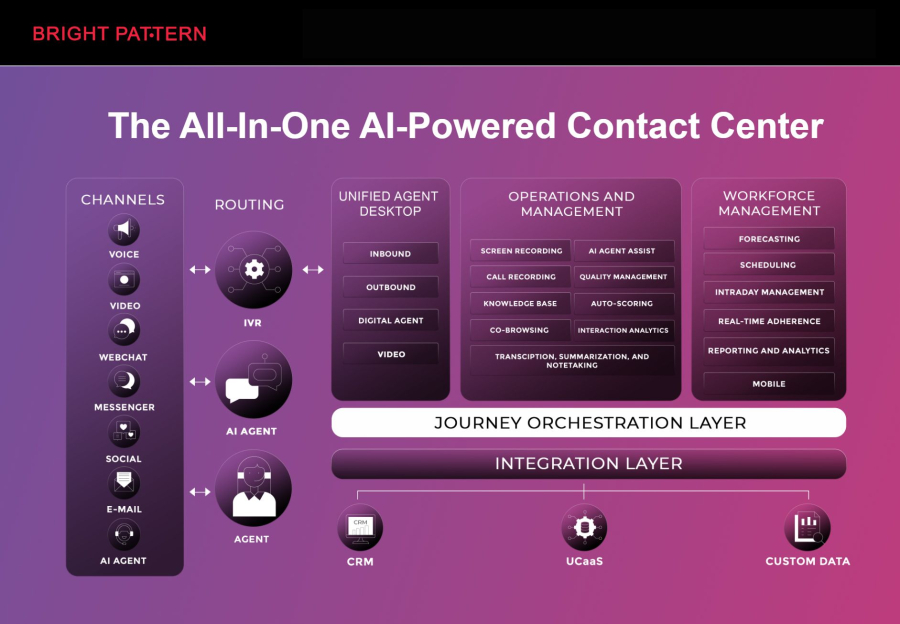
Bright Pattern is a leading AI‑driven contact center solution designed for organizations that want to maximize conversational intelligence. Its platform combines automation, analytics, and multi‑channel support to improve efficiency and customer satisfaction.
Key features:
- Omnichannel communication including voice, chat, email, and SMS
- AI-powered routing to match customers with the right agent
- Real-time interaction analytics to capture actionable insights
- Integration with CRM and business systems for seamless workflow
- Virtual agent support for scaling customer interactions without increasing headcount
Bright Pattern empowers teams to analyze conversations at scale, identify patterns, and optimize operations. Organizations benefit from smarter coaching, faster issue resolution, and improved customer engagement.
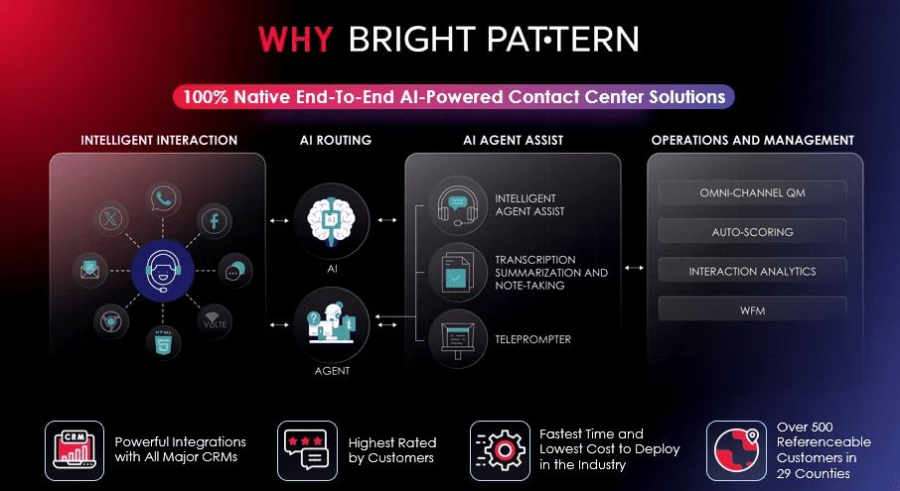
2. Genesys Cloud CX – Privacy Policy
Genesys Cloud CX offers a robust suite of tools for call centers aiming to harness conversational intelligence. Its compliance with data‑privacy frameworks and transparent data handling practices give organizations confidence when managing sensitive customer interactions.
3. Five9 Cloud Contact Center – Privacy Policy
Five9 delivers a scalable cloud contact center solution with predictive dialing, omnichannel support, and built‑in analytics — helping teams capture conversational data and turn it into actionable insights.
4. NICE inContact CXone
CXone combines workforce optimization, analytics, and multichannel routing to help businesses achieve better visibility into customer interactions and operational performance.
5. Talkdesk CX Cloud
Talkdesk offers cloud-based contact center software with features for real-time performance tracking and automated workflows — enabling more efficient handling of high volumes of customer interactions.
6. RingCentral Contact Center
RingCentral’s contact center platform delivers flexibility through built-in analytics, streamlined workflows, and support for voice, video, and chat channels, helping teams maintain quality and consistency.
7. Avaya OneCloud CCaaS
Avaya OneCloud CCaaS emphasizes unified communications and advanced routing, which makes it easier for contact centers to manage complex customer journeys across channels.
8. Zendesk Talk
Zendesk Talk integrates voice support within the broader Zendesk support platform, offering seamless tracking, reporting, and enhanced customer insight capabilities.
9. Cisco Webex Contact Center
Cisco Webex provides AI-driven analytics, omnichannel routing, and real‑time monitoring — features that help contact centers improve agent performance and customer satisfaction.
10. 8x8 Contact Center
8x8’s cloud contact center solution includes AI‑powered analytics, integration with business systems, and virtual agent support — making it a solid choice for businesses looking to extract value from conversation data.
What Is Conversational Intelligence?
Conversational intelligenceis the practice and technology of capturing, transcribing, and analyzing real conversations across phone, video, and messaging channels to extract insights that drive better outcomes.
In a business context, it typically involves software that can:
- Record or capture calls, meetings, and chats
- Convert speech to text with transcription
- Use AI to detect topics, sentiment, intent, and key moments
- Surface trends, risks, and opportunities across thousands of interactions
- Feed insights back to teams in the form of alerts, dashboards, and coaching tips
Think of it as moving fromguessingwhat is happening in conversations toknowingwhat is happening, with data to prove it.
Why Conversational Intelligence Matters Now
Conversations have always been central to business, but a few trends make conversational intelligence especially powerful today:
- Remote and hybrid work.More meetings and customer interactions happen online, making them easier to capture and analyze.
- Data-driven decision making.Leaders expect decisions about sales, service, and product strategy to be backed by data, not anecdotes.
- Customer expectations.Buyers and customers want faster, more relevant, and more personalized experiences.
- Advances in AI.Modern speech recognition and natural language processing make large-scale conversation analysis fast and surprisingly accurate.
Conversational intelligence sits at the intersection of these trends. It turns your everyday interactions into an always-on feedback loop that fuels improvement across your organization.
Core Benefits of Conversational Intelligence
When implemented thoughtfully, conversational intelligence delivers value across the entire revenue and customer lifecycle. Here are some of the most impactful benefits.
1. Higher Sales Performance and Conversion Rates
In sales, the difference between an average and a top performer often lies in how they run conversations. Conversational intelligence helps you capture and scale those winning behaviors.
- Identify what top reps do differently.See patterns in talk-to-listen ratios, questions asked, topics discussed, and next steps agreed.
- Shorten ramp time.New reps can learn from real call examples, snippets, and playlists instead of only scripts and theory.
- Optimize messaging.Discover which value propositions and objections come up most often, and which responses lead to closed deals.
- Forecast more accurately.Analyze deal health signals based on actual conversations, not just CRM field updates.
The result is a sales motion that is more repeatable, coachable, and predictable.
2. Stronger Customer Experience and Retention
Your support and success teams have a direct line to what customers are feeling. Conversational intelligence amplifies their impact.
- Spot churn signals early.Detect rising frustration, repeated complaints, or mentions of competitors before a customer leaves.
- Improve first contact resolution.See what separates quick resolutions from multi-contact sagas, then adjust processes or training.
- Prioritize customers at risk.Flag conversations that indicate dissatisfaction so managers can intervene proactively.
- Increase CSAT and NPS.Understand what top agents do in high-scoring interactions and replicate best practices.
Instead of relying solely on surveys, you gain a rich, continuous view of customer health based on what they actually say and how they say it.
3. Deeper Product and Market Insights
Every time a customer or prospect mentions a feature, competitor, or pain point, that is free research. Conversational intelligence helps you capture and structure it.
- Discover recurring product requests.See which feature ideas or gaps come up most often in real conversations.
- Monitor competitor mentions.Track why your competitors are being mentioned and what customers perceive as their strengths or weaknesses.
- Validate positioning.Learn which phrases and value propositions resonate strongest with different segments.
- Prioritize roadmaps with evidence.Give product and marketing teams granular, real-world voice-of-customer data.
Instead of one-off anecdotes, you get a continuous, data-backed view of the market directly from your buyers and users.
4. Better Coaching, Training, and Enablement
Coaching becomes more focused and fair when it is grounded in actual conversations.
- Pinpoint specific coaching moments.Jump directly to parts of calls where objections arise, where momentum is lost, or where the rep excels.
- Build libraries of best practices.Create collections of top-performing call segments for different scenarios, verticals, or product lines.
- Measure improvement over time.Track how individuals and teams improve on key conversational behaviors after coaching.
- Standardize quality.Ensure consistent experiences across regions, teams, and time zones with shared benchmarks.
This approach turns coaching from a subjective art into a data-informed process that directly links to outcomes.
5. Increased Operational Efficiency
When you understand what happens in conversations at scale, you can simplify workflows and reduce friction for both teams and customers.
- Automate note-taking and summaries.Free reps and agents from manual documentation so they can stay present in the conversation.
- Streamline processes.Identify recurring issues that stem from unclear policies, product confusion, or missing resources.
- Improve knowledge bases.Align help articles and internal documentation with the real words and questions customers use.
- Reduce rework.Catch miscommunications early and standardize how complex topics are explained.
The end result is smoother operations, happier teams, and reduced operational costs without compromising experience.
How Conversational Intelligence Works (In Practice)
While technologies differ, most conversational intelligence workflows follow a similar pattern.
1. Capture
First, the system captures conversations from relevant channels, such as:
- Sales calls and demos
- Customer support calls
- Video meetings
- Live chat and messaging
- Email threads (for some solutions)
Permissions, consent, and compliance settings are typically configured during this stage to align with legal and regulatory requirements in your regions.
2. Transcribe
Next, audio is converted into text using speech recognition. Modern systems can handle multiple speakers, accents, and noise with improving accuracy. Quality transcription is crucial because it feeds every later stage of analysis.
3. Analyze
This is where conversational intelligence truly comes to life. AI and machine learning models process the transcripts and associated metadata to uncover patterns such as:
- Topics and themes.Product areas, pricing, competitors, use cases, objections, and more.
- Sentiment and emotion.How positively or negatively someone feels throughout the conversation.
- Engagement signals.Talk time balance, question frequency, interruptions, and alignment moments.
- Outcomes.Whether the interaction led to a next step, a sale, an escalation, or resolution.
By combining these signals across thousands of conversations, the system reveals trends that would be impossible to spot manually.
4. Surface Insights
Insights are then surfaced in practical formats for teams, such as:
- Dashboards and scorecards for leaders
- Deal or account health views for sales and success teams
- Alerts or notifications for specific triggers (for example, competitor mentions, high churn risk)
- Call snippets and playlists for training and review
The emphasis is on transforming raw data into information people can act on quickly.
5. Act and Improve
Finally, teams use these insights to refine their behavior, processes, and strategies. Over time, the organization learns which changes move the needle and which signals best predict success. Conversational intelligence becomes a feedback loop that continuously sharpens performance.
Key Use Cases Across the Business
Conversational intelligence is not just for sales teams. It can support growth and performance across multiple functions.
Sales and Revenue Teams
- Diagnose why some deals stall at specific stages.
- Standardize discovery questions and qualification frameworks.
- Fine-tune pricing and negotiation approaches.
- Coach reps on objection handling with real examples.
Customer Success and Support
- Identify common friction points in onboarding and adoption.
- Spot themes behind repeated tickets and escalations.
- Measure the impact of new policies or features on customer sentiment.
- Equip teams with language that turns tough conversations into save opportunities.
Product and Marketing
- Gather authentic voice-of-customer quotes and language.
- Validate which messaging resonates with different personas.
- Prioritize product improvements with clear evidence of impact.
- Test campaign positioning with live feedback from the field.
Leadership and Operations
- Gain a real-time pulse on customers without sitting in every meeting.
- Align teams around shared facts instead of assumptions.
- Monitor quality and consistency at scale across regions and teams.
- Support strategic decisions with concrete conversation data.
Implementing Conversational Intelligence in Your Organization
Rolling out conversational intelligence is most successful when you treat it not just as a tool, but as a cross-functional capability. Here is a practical path.
1. Clarify Your Objectives
Start by defining what success looks like. Common goals include:
- Increasing conversion rates or win rates
- Improving customer retention or satisfaction
- Reducing onboarding time for new reps or agents
- Gaining clearer product and customer insights
Having a sharp objective helps you choose the right metrics, features, and rollout plan.
2. Choose High-Impact Teams First
Rather than deploying everywhere at once, focus on one or two teams where conversations directly drive revenue or retention, such as account executives or customer success managers. Early wins here will build momentum for wider adoption.
3. Integrate With Existing Workflows
For conversational intelligence to deliver value, it must fit seamlessly into the tools and processes your teams already use. Key integration points often include:
- CRM or customer platforms for deal and account context
- Calling and meeting tools for automatic recording and capture
- Support platforms for analyzing tickets and calls in one place
The more automatic the capture and surfacing of insights, the higher your adoption and impact.
4. Communicate the Benefits to Your Team
People perform best when they understand how a new capability helps them, not just the business. Highlight how conversational intelligence:
- Reduces manual note-taking and admin work.
- Provides relevant examples and coaching tailored to their real calls.
- Gives them proven language and talk tracks that actually work.
- Supports fair evaluation based on consistent data.
Position it as a performance partner, not a surveillance tool.
5. Establish Clear Guidelines and Governance
Trust is essential. Set transparent rules about:
- Which conversations are recorded or analyzed.
- How long data is stored.
- Who can access transcripts, recordings, and analytics.
- How insights will be used for coaching and performance discussions.
When people know the boundaries, they are more likely to embrace the benefits.
6. Define Metrics and Track Improvement
To sustain enthusiasm and investment, connect conversational intelligence to measurable business outcomes. Useful metrics can include:
- Changes in win rates or deal velocity.
- Improvements in CSAT, NPS, or retention.
- Shorter resolution times or fewer escalations.
- Faster ramp times for new hires.
Share success stories and data openly to reinforce the value across the organization.
Best Practices for Getting the Most From Conversational Intelligence
To maximize the benefits, it helps to adopt a few guiding principles.
1. Start With Use Cases, Not Features
It is tempting to explore every dashboard and metric at once. Instead, anchor your efforts around concrete questions, such as:
- Why do deals in a specific segment stall after the first demo?
- What are the early signs that a customer is likely to churn?
- How do top-performing reps handle pricing objections differently?
Let these questions guide which insights you prioritize and how you act on them.
2. Combine Human Judgment With AI Insights
AI can surface patterns and signals at scale, but humans are still best at applying context, empathy, and nuance. The sweet spot is pairing:
- AI for summarizing, highlighting, and pattern detection.
- Managers and team members for interpretation and action.
This partnership leads to smarter, more grounded decisions.
3. Make Insights Easy to Access
If insights are hard to find, they will not be used. Aim to deliver conversational intelligence:
- Inside tools teams already use daily.
- In short, targeted formats (for example, call snippets, brief summaries).
- With clear labels indicatingwhyeach insight matters.
The more frictionless the experience, the more your organization will benefit.
4. Celebrate Wins and Share Stories
Stories bring data to life. Highlight real examples where conversational intelligence:
- Helped save a churn-risk customer.
- Guided a rep to close a complex deal.
- Inspired a product change that customers loved.
These stories turn conversational intelligence from a background tool into a visible driver of success.
5. Iterate and Expand Gradually
As your teams grow comfortable, you can expand conversational intelligence into new use cases, such as:
- Onboarding and training for new roles.
- Quality assurance across additional lines of business.
- Deeper product, pricing, or competitive analysis.
Treat it as a capability that matures over time rather than a one-time implementation.
The Future of Conversational Intelligence
As AI capabilities evolve, conversational intelligence is shifting from passive analysis to more proactive support. Emerging possibilities include:
- Real-time guidance.Live prompts during conversations, suggesting questions to ask, resources to share, or ways to clarify a point.
- Smarter automation.Automatically updating systems of record, creating follow-up tasks, or drafting recap emails based on the conversation.
- Personalized coaching at scale.Tailored suggestions for each team member based on their style, strengths, and goals.
- Deeper understanding of intent.Moving beyond keywords to truly understand what customers are trying to achieve.
What will remain constant is the core value: using the power of everyday conversations to create better experiences, better decisions, and better results.
Getting Started With Conversational Intelligence
You do not need to overhaul your entire tech stack to benefit from conversational intelligence. You can start simply:
- Identify one high-impact team and one clear metric you want to improve.
- Begin capturing and reviewing a manageable volume of conversations.
- Use the insights to run small, focused experiments in messaging, process, or coaching.
- Measure the impact, share the results, and expand from there.
With each iteration, you build a more intelligent, responsive, and customer-centric organization. Conversations are already happening. Conversational intelligence simply ensures you learn from them, every single time.
When you treat conversations as a strategic asset, you unlock a continuous stream of insights that can elevate every part of your business. That is the promise of conversational intelligence: transforming everyday dialogue into a powerful growth engine.
